This is an old revision of the document!
Table of Contents
Logbook
This is our logbook. We will insert here all relevant information regarding the evolution of our project
Weekly Report
1st Week Report
- We attended the classes;
- We learned about team work, we had a one day team-building activity and we defined our mission, vision, values as a team;
- We decided about the top 3 projects that suit our knowledge and expectations;
2nd Week Report
- Brainstorm about how the sail car will function; what components we need; what materials can we use to be lighter; should it be manual or automatic with electrical components;
- PRMTW: we learned about agile methodology, we had an introduction in project management methodology;
- ESUSD: got to know about the 12 principles of sustainability;
- PORTU: presentations about our countries;
- MACOM: identify our competitors, understand the market right now, define client, decide either B2C or B2B, learn the trends, functional benefit vs emotional branding;
- PROJE: have to start filling wiki, do research;
- Intercultural communication: learned about the difference between different cultures, how to communicate across them, how to understand easy phrases in a foreign language;
3rd Week Report
- Brainstorming about the car frame, sail adjustment
- PORTU: presentations about home countries, learning OneNote;
- MACOM: pitch presentations about projects, defining our client
- ESUSD: learned about pillars of sustainability
- PROJE: discussion about using rigid sail with automatic adjusting system
4th Week Report
- Meeting with the Supervisor about the rigid sail, research about rigid sails, choose a airfoil, ideas of the material for the rigid sail
- Technology Crash Course: Open Source Software, Hardware/Software
- MACOM: Marketing Plan, Ethical and Deontological Concerns, Presentation: Blackbox & Drafts, Team Logo
- ESUSD: Sustainability Indicators
- PROJE: Sprint planing, Backlog, Microsoft Task Manager
- Design Thinking Workshop: create ideas: avoid receipts
5th Week Report
- Meeting with the Supervisor about controlling the servo engine and considering the forces influencing our car.
- Technology Crash Course: Microprocessors, types of microprocessors, advantages and disadvantages. Exercises using TINKERCAD.
- MACOM: Introduction in business CANVAS model
- ESUSD: different perspectives of looking to society, happiness
- PROJE: Sprint planing, Backlog, Microsoft Task Manager
- ETHDO: presentation about real ethical cases
- PORTU: Learned about pronouns, verb to be (ser, estar) and nationalities.
6th Week Report
- Meeting with the Supervisor about finishing the power budget and the best option for the sensor.
- Technology Crash Course: Exercises using TINKERCAD. Arduino knowledge.
- MACOM: Talked about improving our communication skills and seeing something from the perspective of someone else.
- ESUSD: Learned about sustainability in today's companies and society; watched informative videos.
- PROJE: We took a look at our progress in filling the planner and using the sprints as efficiently as possible.
- ETHDO: Talked about the different sides of making and maintaining brand image.
- PORTU: Had a really nice trip around the city, learned about history and culture of Porto.
7th Week Report
- Meeting with the supervisors about the materials, and the structure of the sail car
- Technology Crash Course: Practicing building circuits and programming the Arduino and its modules
- MACOM: Providing help with the Project Management paragraph
- ESUSD: Presentation about the Tibães Monastery
- PORTU: Learned about verbs and numbers
8th Week Report
- In the lessons, last touches and tips for the Interim report and presentation
- PROJE: Interim presentation
9th Week Report
- Easter holidays
10th Week Report
- Selected materials and local providers
- PROJE: meeting about our servo engine, braking system, available materials at ISEP and our list of materials.
11th Week Report
- MACOM: Feedback on our interim report
- PRMTW: Looking over our progress so far, check the planner
- PROJE: Meeting about connections of the mast; a detailed list of components and task to write a scientific paper.
12th Week Report
Student's week
13th Week Report
- MACOM & ETHDO: we need to send the last version of the report to the teacher;
- PROJE: we had the meeting with our supervisors; we spoke with Luis Lima (LSA representative) in order to receive help in making the ribs for the airfoil (wood);
14th Week Report
- PRMTW: Updating the teacher about our progress; analysing the blockers we have.
- PORTU: presentation 1.
- PROJE: Meeting about welding and mechanical workshops; placement of electronic components.
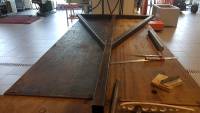
- Prototype: we received the materials, we transport them to school, we had the meeting with the LSA representative; we receive help from one-two of their interns, we went to the mechanical workshop; we cut some parts of the steel in order to be welded.
15th Week Report
- PORTU: test, presentations and the last Portuguese class;
- PROJE:
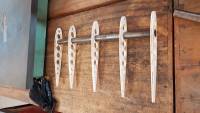
- Prototype: we worked on the mechanical workshop: we cut other parts, we welded some parts; visited LSA couple of times, visited Gislotica, brainstormed in the workshop for ideas, we realized while working that needed to change. We have the ribs for the tail.
16th Week Report
- PRMTW:
- PROJE:
- Functional Tests & Results uploaded on the wiki;
Meetings
1st Meeting (2019-02-21)
Agenda:
- Presentation
- Modus operandi
- Project proposals
- Electronic Logbook
Minute:
The presentation of the project proposals & a session of questions and answers.
2nd Meeting (2019-02-28)
Agenda:
- What materials should we use?
- Should we add electrical components such as sensors, pedal or motor and sensor?
- Should we use/add pedal to start?
- What is the best frame to use (design, front wheel, structure)?
- Should we use a braking system?
Minute:
All of this week’s questions can be defined after doing the State of the art in wiki.
Materials
Depends on the market do we want to make a car for racing, leisure use or something else
For competition - something light, i.e carbon fibre. Sustainable - i.e wood, aluminium
Pedals
Might be dangerous for the kids
Needs transmission, at least to two wheels, that needs an axis
Maybe just dragging feet on the floor to start
Needs a seat
Wind direction detection
Automatic, sensors, anemometer, motor for changing the sail direction - if we want to focus on larger audience, who does not have sailing experience
More manual, with just wind direction indicator - if we focus on people with sailing background
Type of sail
Rigid - hard material, easier to use and adjust
Soft - simpler material, less dangerous, hard to adjust
Brakes
Boats don’t have brakes, use wind to brake
3rd Meeting (2019-03-07)
Agenda:
- Wheels
- Automatic sail adjusting
- Using a winch
Minute:
Wheels
- Our question was about the practical part of the simulation and our need to analyse parts, torsion etc.
- The board advice us to establish exactly about what part of the structure we have concerns and then to ask them.
Using a winch
- A winch is only used on large boats (1, 2, 3 person), larger than 5-7 feet.
- Sail dinghy: no winch, everything is done directly; so for our sail car, we don’t need a winch.
Automatic sail adjusting
- These kind of sails require a lot of trimming, but if we use a rigid sail, it doesn’t change the shape. Rigid sail with a tale means that by default you will be oriented with the wind. So it works in a different way and it is more easier with the rigid wing sail; the other one is more difficult; if we use the rigid wing, we just have to trim the tail (manually or automatically).
- In order to have a more clear vision, on Monday 11.03 we have set a meeting to discuss in detail about the rigid sail and how can we implement the automatically part.
Useful topics for bibliography:
- Overleaf → BibTeX
- In the BibTeX you can define (through Site Map) and in report you just “call” the reference.
- And it will work automatically also for images.
- Check “Examples”.
Hoverboard
- The board advised us to take in consideration the idea of connecting a hoverboard to the kart.
Tables
- We have to make the comparison of the same parameters / features: what is the role of every feature + advantages/disadvantages + should compare them more in detail.
Other questions:
- 1. Do you have any advice for the frame?
- Your first design it will not be the most optimal design.
- 2. Are the simulations enough?
- The type of the sail, the forces generated of the wings → you have the mass of the structure, of the person; you can look at the competition for the sizes; and you can use the books for the forces generated;
- 3. If we want to buy something, we need the bill + the proof that they paid all their taxes.
4th Meeting (2019-03-14)
Agenda:
- Relationship between velocity, angle of attack and apparent air
- Lack of programming skills
- Our logo ideas
- Does automatic sail adjusting have a marketing perspective?
Minute:
Relationship between velocity, angle of attack and apparent air
- Lift force is perpendicular to the apparent wind
- Drag is in the same direction as apparent wind
- Analyse different attack angles and compare the results
- The y axis component of Lift represent the direction of movement (in this case-photo)
- Analyse the total drag force ( from sail, from wheels, …)
Automatic sail adjustment
In order to make the sail automatic, we need these parts:
- Actuator
- Sensors
- Servo Motor
- Energy source
We have to figure it out how can we switch from automatic sail adjustment to manual controlling.
Programming issues
The automatic sail adjustment does not need that high level of programming, we can ask for help from the teachers, and we can use scratch, where we can write simple loop programs.
Logo
The board commission liked our logo ideas. We have to make some modification about the letter “i”, to be obvious its “sailo”, not “saplo”.
Modification in the Wiki
- We have to add the references inside the sentence using “bibtex.verbosus”.
- Complete the conclusion part of the state of art based on our previous studies.
- Redo the black box
Breaking system
We have to find out a way how we going to park the car.
Possible solutions:
- Handbrake
- Push button –> automatically unleashes the sail
- Obstacles between the wheels
- Child car braking system
Rigid sail material and size
Roof mate is a good idea because it is lighter than wood, but we have to cover the sail with a stronger material (probably with fibre glass). We should also consider to design different size of sails, for beginners and for advanced drivers.
5th Meeting (2019-03-21)
Agenda:
- How is the most convenient to control the servo manually?
- Friction of the wheels
Minute:
Controlling the servo engine manually
Should override the servo. Similar to the Cruise Control.
On a sail dinghy there is a extension to the rudder, just move the vain. It is difficult to just override the servo and control it manually. Possibility is to have a microcontroller, which has a program on it what normally controls the Servo. We can program the microcontroller to override the automatic control and give the driver the option to control the servo manually i.e. with a joystick.
Other option is to add a electrically controlled clutch, which helps to change from one driving mode to another.
Forces
How much force is needed to move the car?
We should take in consideration the weight of the frame and the weight of a normal person.
We need to know type of tyres and the type of ground the car will be driving on. More inflated tyre will have less friction. Research on rolling resistance. Overall wheels are a part of the car, which is easy to change. Depends where we are, we can have different types of wheels for different surfaces.
Do some reverse engineering, dimensions of other sail vehicles. How much force do they need to move?
Force needed from the sail needs to overcome the friction. First thing to think about is the surface, then we can estimate the friction, then think how much acceleration we want on the vehicle, from there we can decide the dimensions of the wing and the types of wheels and tyres.
Report
Chapters 1, 3, 4, 5, 6, 7 half of them should be ready by now.
In schematics we need to have a table with several options for different components, not just here is microelectronic and here is servo motor etc. After that we need to do a power budget.
6th Meeting (2019-03-28)
Agenda:
- Wind sensor - buying one or building it ourselves?
- If we build it ourself, is it a good idea to use a rotary encoder?
- Selecting the servo motor - how to find out required torque?
- Battery-sizing
- Some references do not work correctly
Minute:
7th Meeting (2019-04-04)
Agenda:
- Materials - stainless steel or aluminium? Chosen stainless steel is not available in Portugal.
- Welding or fitting pipes (the wheels and frame)?
- The placement of the shaft and production/process.
- Can the wing be dismountable if we make it in sections?
- Extending the ribs.
- Thickness of the ribs inside the wing.
- Servomotor: is correct to use the distance of the main mast to the tail mast times the maximum lift force on the tail.
Minute:
- 1. Materials - stainless steel or aluminium? Chosen stainless steel is not available in Portugal.
The teacher commission recommended us to send an email to the German producer company - maybe they will even send us some materials. From a sustainability point of view, it's not a problem that is from Germany, because the most part of the steel comes from China.
They also told us that we should understand the difference between the prototype and the product we are going to sell. For the prototype we will use cheaper materials with lower quality, that will prove that our idea/solution/concept works. It will be the only thing that we will build for real. Based on our research, on our functional tests and so on, we will define how our selling product will be - the further development part of the chapter 8.
Easy + not very expensive → Testing & an adapting prototype to be easily changed → How we will produce another product, mass product, based on our experiences with this prototype.
The commission also stands out these points:
- Stainless steel is very expensive
- The sharp stainless steel is not really steel or stainless
- We should use for our prototype just steel and painting for anti-corrosive purpose
- For the selling product, we can take in consideration also aluminium profile (Bosch T-profiles, aluminium), bicycle frames and window frames
- For the selling product, we can search about standards about corrosion resistance (aluminium, zinc etc.)
- To take in consideration two types of marketplace: near sea/ocean or countries that are not open to the sea, but have good wind condition.
- Regarding the tires: they have to be more or less inflated, depending on the surface (dry or hard sand) and how aggressive the environment will be, because they will influence the propelling force.
- We may have a problem with starting the motion of the car;
When we are discussing about materials, we should take into consideration:
- Easy development
- How light is it
- Accessible
- Cost
- 2. Welding or fitting pipes (the wheels and frame)?
- 3. The placement of the shaft and production/process.
To prevent axle to go out, the teacher commission showed us as an example how the wheel from wheelbarrow is attached + another system that prevents the axes to go out.
- 4. Can the wing be dismountable if we make it in sections?
For the prototype we should not complicate it and make the wing in sections, but has to be dismountable. It will have the mast and the tube inside. The wing has to be built around the tube.
For the future development part we can say that we want to be able to be broken into sections in order to be easier to transport.
- 5. Extending the ribs.
OpenCad vs. SolidWorks; The commission recommended us to look for PVC and silicon glue, because we will use wood too and it will seal humidity.
- 6. Thickness of the ribs inside the wing.
For the chosen wood we have to look for characteristics to see if it bends. Ana choosen balsa, that has a lower density, but balsa it is relatively fragile. To solve the problems with Macros in SolidWorks we can contact these teachers: Ruis Fazenta or Pinho.
- 7. Servomotor: is correct to use the distance of the main mast to the tail mast times the maximum lift force on the tail.
- 8. The INTERIM presentation
- 10 minutes presentation;
- The report ready by 7.04.2019;
- All points from Chapter 1 (introduction) to Chapter 7 (Project Development - 7.6) completed;
- We should follow the outlines: the problem, marketing, ethics, environmental, solution;
- We will receive an assessment form to assess ourselves and our work;
- After presentation, we will receive questions from the commission and from our teachers too.
- 9. Other discussed subjects
- On 6.04 Saturday we will have the Tibaes monastery trip;
- On 12.04 Friday we will have the Paiva Walkways trip from 8.00 to 19.00.
8th Meeting (2019-04-24)
Agenda:
- Is our servo appropriate? (Will bring it to the meeting)
- Which brakes should we use?
- Are there some materials in ISEP?
Minute:
Servo
- The servo engine is decent, torque is good
- We can use this
Brakes
- We are thinking about using a bicycle like a system on the car, but the price is a bit high.
- Would it be more reasonable to build it ourselves? No, that could actually be more expensive
Materials in ISEP
- Same materials on chairs and tables.
- We can visit the storages, where are some old materials. Benedita will arrange a meeting for us to go and see if there is something we could use.
- We will definitely need to buy the main rectangular profile and the mast.
- Is there some PVC also available in ISEP, because we will need a lot of it, and the rolls in Leroy Merlin are quite expensive since we need about 18 rolls and one costs 10 euros.
- There is some, but since your wing will be quite big, there will not be enough material available.
- Probably we will not need so many rolls of PVC, the amount will be roughly 6 square meters, so it will not be so expensive.
- The information on the website is confusing, but it seems that the price represented there is actually for a square meter
List of materials
- We will need to find a company ASAP for the rectangular profile, because the clearance of the companies will go through the financial department, and this will also take some time.
9th Meeting (2019-05-02)
Minute:
- We discussed with the supervisor commission about other ideas regarding the mast connection; the conclusion was that more specific drawings are needed about the mast part;
- A more detailed list of items and prices is needed;
- We have to submit our projects' paper until the 17th of May and to send it to supervisors until 14th of May; we will use OverLeaf;
10th Meeting (2019-05-14)
Agenda:
- Where can we build the car?
- How can we cut and model the wood, what are the opportunities in ISEP?
- Do we use PVC or some alternative for the wing?
- Is there another potential sponsor?
- Problem with the paper layout in PDF format.
Minute:
Building the car
LSA lab/ F laboratories.
Modelling the wood
LSA and talk with Luís Lima.
Wing material
The commission recommended us to first build the ribs and then decide what material will cover them.
Sponsors
LSA
Paper
The commission helped us with fixing overleaf errors. We still need to fix: SI units, images to be bigger or on the same line and using i, ii, iii format. the new deadline for the paper is 17th of June (we will have the results of the test included).
Flowchart
Feedback: needs to be done again with the correct format.
11th Meeting (2019-05-23)
Agenda:
- Can we weld in school or in the company?
- Can we use the mechanical workshop?
Minute:
Welding
Only people, who know how to weld, and have been welding 200 hours, can weld at the school workshop. There are two technicians in school, who can do that, but since they have other assignments, so they cannot do the work for us. We should prepare everything for welding, so it will be taken to a company owned by one teacher and welded there.
Workshop
They are very tight this year because there was an accident, so they are not letting everyone use the machines. All of the times requested have been approved. We can start working there tomorrow (24.05) Benedita will share the document with available times and workshop regulations with us. Every time you need to go there you need to let us now.
Programming
How is the coding coming along?
It is fine right now.
Let us know when you need a protoboard.
Placement of electronics
We need to know where all of the components will be placed, because of the needed wires connecting all of those. We will need to provide the supervisors with the drawings of the placement of the components.
12th Meeting (2019-05-30)
Agenda:
- What must the video be about, the process of making it or similar to an advertisement?
- The sail's outer material
- Does the Manuel Silva teacher have the aluminium tube and rods for moving the tail?
- Who can give us feedback on our paper, that has the deadline on 17th June?
Minute:
Video
There is no certain template for the poster, brochure and the video. There are last years videos on youtube so you can watch those for inspiration. Make the video interesting and appealing and not too long.
The sail's outer material
We still need the frame for the mainsail first.
Aluminium tube and rods
He will have those, but we need to provide the dimensions.
Feedback on paper
We will receive it next week.
13th Meeting (2019-06-05)
Agenda:
- Where can we solder electronics?
- Problem with the front wheel steering.
Activities
Please register here all accomplished project activities
| Start | End | Task | Description | Who |
|---|---|---|---|---|
| 7.03.2019 | 7.03.2019 | Gantt chart | Creating the Gantt chart with the tasks and time according to the team | Karl |
| 7.03.2019 | 11.03.2019 | Black box system diagram | Creating the black box system diagram with input and output | Levi |
| 7.03.2019 | 11.03.2019 | Structural drafts | Creating the structural drafts | Ana |


